
History
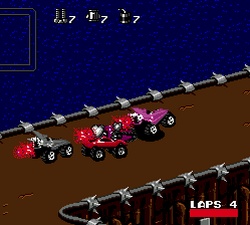
“Rock n’ Roll Racing” is the quintessential combat racer—engines howling under guitar riffs while rockets and mines streak across an isometric track. On the SEGA it was pure white‑knuckle arcade: blast off, punch the turbo, outbrake rivals in the bends, dump an oil slick—and a gravelly announcer is roaring through your TV. Fans called it “Rock-n-Roll Racing,” “Rock & Roll Racing,” or just “rock racing”; you’d even hear “R’n’R Racing.” It felt like a Friday night: dusky space circuits, bright muzzle flashes, heavy riffs and shameless fun. You’d fire it up after school not just to win, but to do it with flair—a power-slide to a screaming guitar and a salvo of rockets. Why does it stick? Because every victory hits louder than any fanfare—like a guitar solo scraping the speakers and your heartbeat. We’ve got a separate piece about how this legend came to be and its road to fame.
Pop the “Rock n’ Roll Racing” cart in and you get everything we love about 16‑bit classics: a racer’s career with upgrades, weaponized rides, pick‑up‑and‑play simplicity, and a relentless rush. It’s an isometric brawler on wheels: grid start, paint-trading duels, ramp jumps, lap bounties, armor and suspension upgrades—then back on the throttle. Two players on one couch was where it truly shined: friendly rivalry, local co‑op, playful trash talk, and that eternal “one more lap.” On the SEGA Genesis/Mega Drive it felt like a tour of the galaxy: new planets, tempting upgrade bays, and on‑track skirmishes that became little tales of neighborhood champs. The soundtrack is a headliner of its own—the rock standards you still catch yourself humming. For more names, dates, and trivia, check it out on Wikipedia, but honestly, it’s better to crank the volume and dive back onto the track.
Gameplay

Two seconds in and you’re already strapped in: isometric cam, spotlights in your eyes, bass thumping your ribs, the announcer trash-talking — time to burn rubber. Rock n Roll Racing — the one and only “Rock & Roll Racing”, just straight-up rock ’n’ roll racing — where the launch is a hit of pure adrenaline. This isn’t just an arcade racer, it’s a combat racer: turbo under your thumb, drift in your blood, the rival’s tail in your sights. Click — rockets streak ahead; whoosh — mines sit right on the apex; splat — oil smears the line for anyone chasing. Sand ruts tug you sideways, ice patches force you to catch slides by instinct, mud sands your speed down to a patient lunge. The camera fishtails with you, every bump landing on the snare. Hairpins, ramp jumps, hard shoves, a random crate of credits — and you’re already calculating if it’ll cover a new suspension. Every second hits like a favorite riff: the straight is the verse, the corner’s a bruising chorus, and the solo is you on nitro gunning for the checkered.
Between heats comes the sweet agony of choice. Credits beg to be spent in the upgrade shop, where tuning genuinely changes the ride: studded tires, reinforced armor, a meaner engine, extra turbo, a heavier rocket launcher — suddenly Rock n Roll Racing (some just call it “racing to rock”) sounds brand-new. Shift the balance, change the style: go surgical on the line or go full bumper-and-sparks. Planets toss out trials: lava canyons, dusty oval speedways, slick snow loops — every track sets its own tempo, its own breath. And the cherry on top is two-player: split-screen doesn’t just slice the view, it splits the hype. You dive-bomb your buddy into the last corner, he answers with a mine at the tape — and the room explodes with more than the heavy soundtrack; it’s laughter too. In the gameplay breakdown — timing your turbo, handling across surfaces, and that moment when the stage is yours and you’re playing riffs with throttle and nerve.