
Rock n Roll Racing story
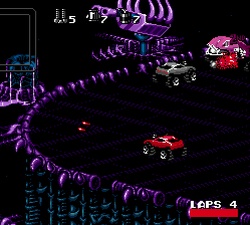
Rock n’ Roll Racing was born at the crossroads of two simple urges: to tear around until the tires scream, and to make the guitars snarl louder than the engines. The upstart studio Silicon & Synapse — the one that would become Blizzard Entertainment — already knew how to ship arcade hits and was hunting for an idea that would punch straight through the 16‑bit zeitgeist. They found it fast: “racing” and “rock” clicked like puzzle pieces. There was a warm‑up act in RPM Racing, but this is where the formula snapped into focus — isometric tracks, weaponized driving, and, over the top, those unmistakable riffs that make you mash the throttle.
While alien worlds and audacious rides were sketched on paper, the team was grinning: what if the game sounded like the neighbor’s garage vinyl spinning at full tilt? No half measures — grab legendary themes and squeeze them into chiptune form. That’s how Paranoid, Highway Star, Born to Be Wild, and Bad to the Bone roared into the game — not one‑to‑one, but so recognizable they gave you goosebumps. And when the race intro hits with “Let the carnage begin!” in Larry Huffman’s signature bark, you know you’re in for a show.
With that swagger, Rock & Roll Racing stood out from the pack. You weren’t just circling a track — you were staging gladiator bouts. Drivers felt ripped from a comic book: punks, villains, aliens, each ready for their own poster. The design hooked with a fair, feverish loop: split‑screen flipped on instant couch co‑op, and the courses felt alive — dusty canyons, frozen planets, oil platforms with leaps and cheap shots. But that’s more for /gameplay/ — in the history lesson, the headline is the vibe born from attitude and music.
How rock fit into a cartridge
Licensed rock bangers in a 16‑bit cart felt almost defiant. How do you cram that much power into plastic? Answer: don’t chase the arena mix — capture the spirit. The tracks were rearranged smartly: short, chunky, instantly identifiable riffs. They became part of the emotional HUD, right alongside turbine roars and tire squeal. That’s where the magic sparked: an isometric racer suddenly had a voice — brash, loud, tongue‑in‑cheek. The commentator sprinkled salt on every scuffle, needled your wins and whiffs, and you rode the high where the music wasn’t background — it was fuel.
That personality is why it stuck. Rock n’ Roll Racing never pretended to be a solemn sim. It dove headfirst into arcade aggression: wreck a rival, snag an upgrade, outfox a corner, slingshot onto the straight — all to a beat you’d recognize even if you’re not a hard‑rock diehard. And the name had a life of its own: box art said Rock’n’Roll Racing, magazines flashed Rock & Roll Racing, and around here folks simply called it “rock‑and‑roll racing on Sega” — informal, friendly, straight from the heart.
How the game spread worldwide — and to us
In the West it landed as a loud 16‑bit classic: combat racing with a style you couldn’t mistake. But legends aren’t forged only on store shelves. In our mid‑’90s reality it played out differently: street markets, walls of bare cartridges, homemade stickers shouting “Rock n Roll Racing for Sega,” weekend rentals, and game rooms where split‑screen pulled a crowd around a single TV. Bootleg carts passed from hand to hand, and the stories traveled with them: “maxed my ride today — steamrolled tomorrow,” “spun out on the ice — clawed back with nitro.” That’s how it turned into a folk legend — not just a title, but a reason to meet up and throw down.
That hand‑to‑hand spread — scribbled “guides” on scrap paper and debates over the best upgrade — cemented its warm nickname for us: “rock‑and‑roll racing on Sega.” In it lived the platform, the feeling, the memory of evenings with the volume dimed and every corner a dogfight. For some it was a first brush with combat racers; for others, the go‑to co‑op where you played with your hands and with a smirk, because a sly bumper tap at corner exit counted as much as a perfect lap.
In the end, that cocktail of speed, a rock soundtrack, and a mischievous play‑by‑play just worked. Rock n’ Roll Racing turned every grid into a stage entrance: lights, noise, “Let the carnage begin!” — and you’re already in character. People don’t recall it by release dates but by feel: the way you carved a bend under a familiar riff, split the screen with a friend, and turned each race into a tiny concert with gasoline for pyrotechnics. Because some games have a soul that roars to life on the first chord.